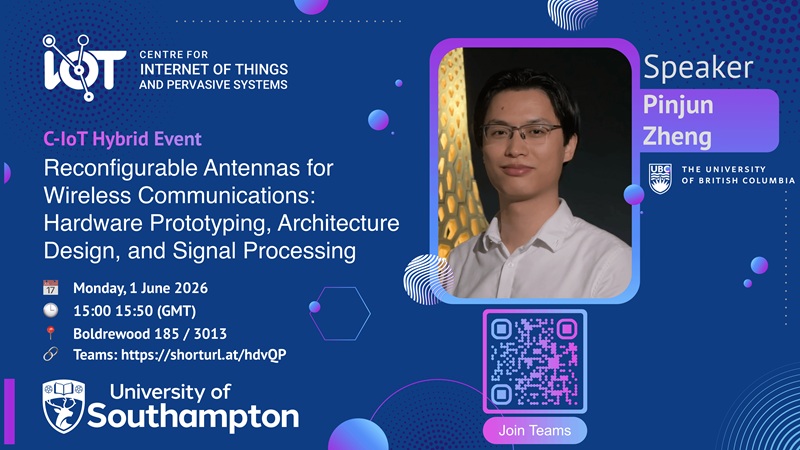
Seminar: Reconfigurable Antennas for Wireless Communications: Hardware Prototyping, Architecture Design, and Signal Processing
Monday 1 June 2026, 15:00 - 15:50 (GMT)
Boldrewood, Building 185, room 3013
Speaker: Pinjun Zheng, The University of British Columbia, Canada
Teams: https://shorturl.at/hdvQP
Abstract: Next-generation wireless communication systems call for a more balanced design that jointly considers data rate, power efficiency, and hardware cost. However, as MIMO systems scale to increasingly large dimensions, power consumption and hardware complexity become major bottlenecks. Reconfigurable antennas provide a promising way to address these challenges by introducing an additional degree of freedom at the electromagnetic (EM) level, enabling more adaptive and efficient signal transmission and reception.
This talk first reviews recent advances in reconfigurable antenna hardware and then presents a digital–analog–EM tri-hybrid transceiver architecture that exploits such EM-domain reconfigurability. Furthermore, we discuss the signal processing and optimization challenges introduced by such new architectures, with particular emphasis on the role of deep learning in developing efficient and scalable solutions.
Bio: Pinjun Zheng received the B.S. and M.S. degrees from Harbin Institute of Technology, Harbin, China, in 2019 and 2021, respectively, and the Ph.D. degree in electrical and computer engineering from the King Abdullah University of Science and Technology (KAUST), Thuwal, Saudi Arabia, in 2024.
He is currently a Postdoctoral Research Fellow at the School of Engineering, The University of British Columbia, Okanagan Campus, Kelowna, Canada. He received the Canada Postdoctoral Research Award from the Natural Sciences and Engineering Research Council of Canada (NSERC) in 2026. He is serving as an Associate Editor for IEEE Wireless Communications Letters.
His research interests include signal processing and deep learning, with a particular focus on their applications in wireless communications and radio localization.