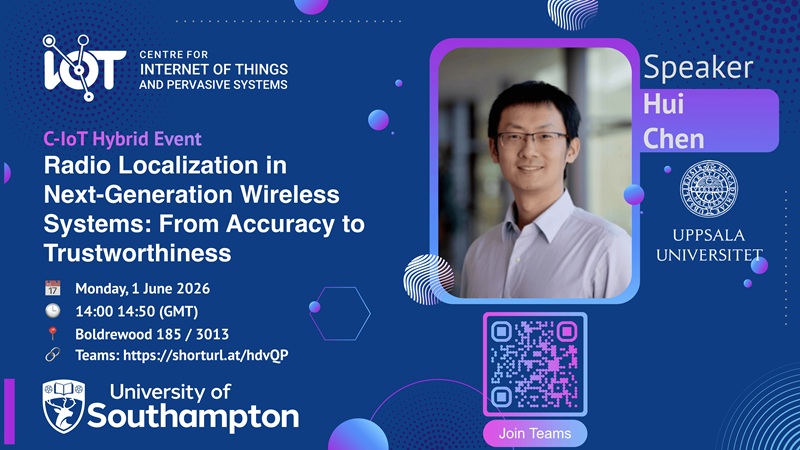
Seminar: Radio Localization in Next-Generation Wireless Systems: from Accuracy to Trustworthiness
Monday 1 June 2026, 14:00 - 14:50 (GMT)
Boldrewood, Building 185, room 3013
Speaker: Hui Chen, Uppsala University, Sweden
Teams: https://shorturl.at/hdvQP
Abstract: Radio localization is a key enabler for next-generation wireless systems, supporting applications such as autonomous systems, digital twins, and immersive services. While significant progress has been made in improving positioning accuracy, emerging use cases require a shift from accuracy-centric design to trustworthy localization. This calls for systems to know what to trust, when to doubt, and how to protect.
In this talk, we argue that localization systems should be understood through the lens of the CIA triad, namely, confidentiality, integrity, and availability. Confidentiality concerns protecting location information against unauthorized inference and privacy leakage. Integrity relates to the reliability of localization outputs in the presence of calibration errors, measurement uncertainty, and potential faults. Availability captures the ability to provide continuous and timely localization under challenging conditions such as interference, blockage, and network dynamics, where environmental awareness and redundancy play a key role. We highlight key scientific challenges, including fundamental limits under uncertainty and model mismatch, detection and mitigation of faulty or malicious measurements, and trade-offs between accuracy and privacy.
Bio: Hui Chen received his Ph.D. in Electrical and Computer Engineering from King Abdullah University of Science and Technology in 2021. He is currently an Assistant Professor at Uppsala University, Sweden, and is also affiliated with Chalmers University of Technology, Sweden, as a Staff Scientist, and University College London, UK, as a Marie Skłodowska-Curie Fellow.
His research focuses on 5G/6G localization and sensing, distributed integrated sensing and communications (ISAC), and machine learning for signal processing, with more than 80 journal and conference publications, 4 book chapters, and 2 US patents.
His work has contributed to major European and Swedish research initiatives, including HEXA-X, HEXA-X-II, RISE-6G, and 6G-DISAC. He is the recipient of the EU Marie Skłodowska-Curie Actions Postdoc Fellowship, the Swedish Vinnova International Mobility Grant, and the Ericsson Research Grant.
He currently serves as an Associate Editor for IEEE Communications Letters (Exemplary Editor in 2025) and IEEE Open Journal of the Communications Society.